What is the logical status of Divine scripture? We answer informally and then formally.
1.
Consider two statements. The first is made as an ordinary, dull judgement, and is written without any attempt at positioning any submissive property of its signs:
I am going to the shops to buy a litre of milk.
The second is uttered in illumination, possessing the same property of light held by all holy speech:
A polytheist was the guest of the Prophet Muhammad. The Prophet gave the guest the milk of seven goats. The Prophet did not stop offering the guest milk until he was satisfied. (Sahih Muslim 23:5120, a narration attributed to Abu Huraira)
Both statements involve the sign “milk”. Following the philosophers, the sign for “milk” is not fixed, and has a meaning that is necessarily deferred to the absolute Other (the left eye of the Face in our recent discussion). Both sentences have made an attempt to position and attribute an absolute value to “milk” in the context of their language game (one game might be a conversation with a friend, the other might be the game of hadith telling) and both can be taken in a way that is not illuminated.
But the second speech act is readily taken as illuminated, because the essential, deferring, submitting nature of the sign “milk” is here used in a mode of self-awareness. The hadith narrator is aware that “milk” is a sign that, like all others, defers to God, and utilizes this in the story by providing an explication of milk that judges (however partially) according to a mode of submission to the Beloved. All signs are are Godly in a way that cannot be fixed absolutely by judgement.
The story could be understood as an attempt to position “milk” as Godly according to a particular mode (say, as indicating a conduit of Divine gnosis). All positioning of signs is ultimately inadequate: but in this case, because the judgement and positioning is self-aware, because “milk” is indeed Godly, the inadequate attempt at positioning milk, while not valued as “true”, is still conducted in an illuminated way because the property of the sign’s ultimate deferral to God is made manifest to the reader as a guest of Prophecy. (The hadith teller does the same thing with the number 7).
The value of the judgement is, of course, still subject to infinite deferral. Someone might ask: what exactly is meant by “milk” in the story? And an interpreter might then make an explanatory judgement of the form: in these hadiths, “milk” means a channel of Divine Wisdom to us. And then they might be asked: but what is a “channel” and what is “Divine Wisdom”, and so on, ad infinitum. But in spite of the judgement being essentially non-valuative, it is self-aware and illuminated, because it has utilized the implicitly submissive property of the signs to bring out, explicitly , a mode of submission to the Beloved in its limited explanation.
What we call God’s Judgement a Cosmic Logic or Shariah: the law of differentiation that is constituted by is the placement of sparks within the signs (within all signs) of cosmos. The sparks are the light of indication to Truth. A spark is hidden within a sign in the sense that its deferral is implicit in the ordinary ways we judge with signs. But, through an illuminated judgement, we can bring out, make explicit, a the mode by a sign indicates or submits to the Beloved.
Depending on where we stand, on how we judge, we locate this light, reflected in the signs, as sparks revealed. If their submission, their deferral the Other, is a form of hiding or withdrawal , then our illuminated judgement is their restitution.
The seeker's objective is nothing less than the repair of the fabric of reality. And is exactly the process of living life in illuminated judgement.
2.
Sets are collections of objects. If People is the set of all people alive today, an Bilal is a person, then we write Bilal in People to denote the fact that Bilal is a member of the set of all people. Equivalently, we can write People(Bilal) -- treating the set People as a logical predicate whose valid application is any person that it contains.
In logic, an ordinary predicate applies to a limited range of objects (even if infinite, still limited). For example, IsBlue(x) might be a predicate that can apply to any x that possess colour: skies, toys, chairs, houses, etc. It might not apply to, for example, numbers or sounds.
A symbolic function, in contrast, predicates over everything, including itself and its possible modes of inhabitation. It reflects its own place in the process of signification that we call life. It reflects its own place in the process of proof, our lives lived in Logical, True Time. A symbolic function thus totalizes the entire cosmos. If Milk(x) is Divine Wisdom inherent and communicated by all signs x of creation, then
Milk = { w | w = Milk(x), for any sign x}
And so, specifically, the Wisdom that Milk’s nature is Wisdom is a self-reflexive predication
Milk in Milk
because Milk is still a sign and so
Milk = Milk(Milk)
In terms of the individual’s journey of judgement and reading, for this totalizing property to be unlocked in {\em our} reading, the symbolic function must be counterposed in a relationship of predication with other signs. It must be seen to predicate over all proofs, all inhabitation, all lives through encountering the sign’s predication over our reading, over our life.
Then Wisdom is communicated actively through Milk. For milk’s property of a Divine Wisdom transmitted through the hadith, to be unlocked by us, it must be served to us a guest : these three signs must be counterposed within the hadith that is Prophecy’s house , so that the function of milk predicates over the signs of serving and guest. We intimated this by means of a proof tree:
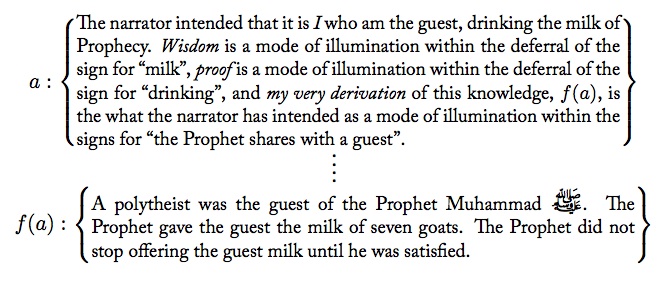
The notation is as follows: the dots of the tree represent the process of logical deduction, of proof, of how we arrive at the bottom conclusion from the assumption at the top. Importantly, we also denote the proof itself as a function object f that applies to the assumption object a. Observe that the property of self-reference is given by the assumption and conclusion referring to the proof -- referring to the way in which we are reading the hadith.
In doing this, the following predication was affirmed
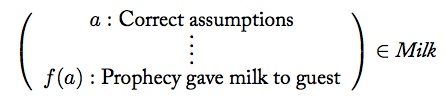 because to comprehend the True property of drinking milk is Wisdom.
Wisdom is the comprehension of what our situation as guest in the hadith entails.
This is because
Proof/Drinking in Milk
which is the same as the predication
Milk(Drinking)
But the comprehension is bidirectional, because Divine Wisdom’s definition is predication over all signs, all things in the world, all lives, all entities, all proofs, all consumption, all predication.
That is, if Drinking(x) is proof/reading/communication of all signs x of creation, then

And so, specifically, Drinking/consumption/communication/proof/inhabitation is
a symbolic function, defined by self-reflexive reflexive predication
Drinking in Drinking
becauseDrinking** is both a sign, but can be drunk as a proof such that**
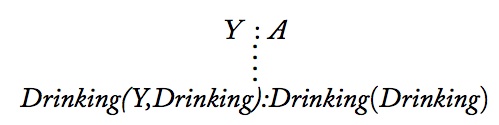 beginning with any set of assumptions A within any logic of any individual journey/proof (everyone will eventually read and understand**** Chapter 3 of the Tailor’s Doctrine).
To drink is to prove anything, including (when we begin with the correct, Muhammedean assumptions regarding signs) the Wisdom inherent in the sign of drinking. To drink is to drink.
But the proof above, from a to f(a) was exactly the Wisdom recieved by the guest/reader. Wisdom is that particular form of proof. Milk pours fourth from the trace of the proof and so, generalizing, we have that
Milk in Drinking
which is the same as asserting the predication
**Drinking(Milk)
**
The central formal tenant of the Supreme Tailorite Logic -- the Tailorite Tertium Organum -- is that this form of bidirectional, mutual predication of this particular pair of facts -- Drinking(Milk) and Milk(Drinking) -- occurs throughout all life and, specifically, characterises every configuration of signs within the Holy Books and Divine narrations. The pattern of mutual predication between signs will repeat itself over and over.
So, for each sign/predicate pair, rather than revisit the same argument as we have just done with Milk and Drinking , we will instead often
defer to the graphical representation below:

The figure illustrates a binary complex , to borrow the psychoanalytic term: the mutual predication of two symbolic functions P and Q.
Both functions predicate over the entire cosmos of signs, including themselves. Their nature as such is a Wisdom that is unlocked via illuminated judgement: this is brought to us through reading a complex of their particular mutual predication: P in Q and Q in P (or, equivalently,
Q(P) and P(Q)).
When we wish to explore the implications of a particular direction of predication, we will employ an arrow from the node of the graph representing the predicate to its subject. This will be necessary because, as we have already seen, the logico-temporal order of the arrangement of signs is crucial in eliciting an illuminated conclusion. And because it is this order that is a felt, physical effect that regulates our proofs. However, it is important to remember the self-predicating, totalizing nature of the signs under consideration and the fact that an opposite direction is implicit within the relationship.
In general, a story or law in written the Divine Revelation itself or in authentic trace of Revelation’s unfolding defines a particular complex consisting of a number of signs, each a symbolic function that, while totalizing the cosmos, holds within it Divine Wisdom that is unlocked through our reading of its bidirectional predication with the other signs of the text. For example, the signs within the hadith of milk and the polytheist form the following complex:
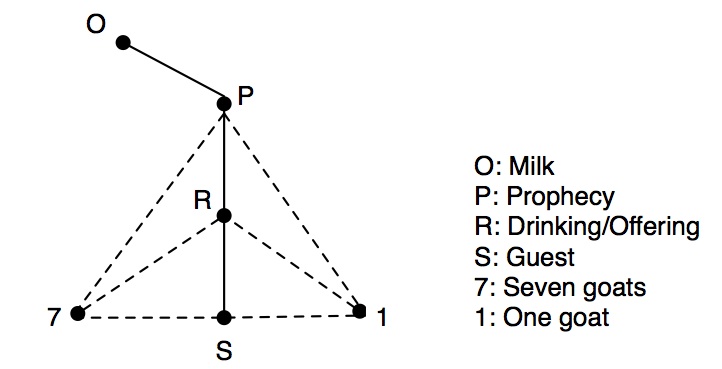
We have discussed the bidirectional predication between the guest (as our subjectivity engaged with the communication of milk), the milk (as the Wisdom inherent in all deferral to the Beloved Other), Prophecy as the communicating conduit through which milk is Offered to, and derived/proven by, our reading/drinking. These symbolic functions stand in mutual predication with each other. The signs of the seven goats and the one goat have a similar totalizing nature as symbolic functions, but a different purpose within the overall complex of the hadith.
We defer a deeper examination of that purpose to another time: our intent here was to sketch the general logical status of Divine scripture. And Allah knows best.