 Note 1: Disbelief and garments
No doubt! They did fold up their breasts, that they may hide from Him. Surely, even when they cover themselves with their garments, He knows what they conceal and what they reveal. Verily, He is the All-Knower of the breasts.
(11:5)
The breast of the human is a surface, a plane of earth upon which signs are inscribed, that extends as a continuum and has no below nor above with respect to the process of signification: it is a plane of immanence that, when considered locally, forms individualities, subjecthoods. This entire surface is known as the Logos, the real body, that which is the word “Be!” from the Love. The surface is God’s Knowledge, Loving to be Known through that word. But to fold this surface is to double, to take that plane and fold it (locally) upon itself, creating the (local) impression of a difference, of an above and a below, of a semantics of signs on one side of the fold in subjecthood to other privileged signs on the other side of the fold.
It’s a trick of topology that constitutes an sense of selfhood that can be deceitful in that its locality gives the appearance of a hidden interior life divorced from the actual reality of this surface. The locality of the fold is an illusion inasmuch as it implies a hidden interiority of subjecthood distinct from the actual Body (it creates a false sense of the material rather than the actual Flesh of the Vine that is the surface). The surface -- the breasts -- is God’s Knowledge, God’s signs, so both sides of the fold are part of the same surface, part of the same knowledge.
Is there a “True locality” to this space or is locality an illusion that the Sufi works to disengage from? Yes, though we live our lives beginning with the single Logos of an Adamic plane, sublimated to the journey as a result of its surface being susceptible to this process of folding (which, from another perspective, is a rippling that shatters its perfection and unity into differences) ... It is actually via locally noble, correct reading, corrective speech, enunciated within individual and local regions or plateaus of the immanence that something greater than the original surface becomes Known: a messianic age of perfected, corrected shards. God’s speech running through to correct, so that the Love song is heard in its fullness. It is local speech that makes for the orchestra of fulfillment -- though closed folds do not permit voice, they are silences that are unfolded (according to the principles of warfare, of jihad). Without locality, the song would exist only as potential within the unified surface of the breast -- by becoming plateaus of breasts in plural, the Love song is heard in full.
Note 2: Listening and seeing
The example of the two parties is like the blind and deaf, and the seeing and hearing. Are they equal in comparison? Then, will you not remember? (11:24)
These “two parties” are the dual aspects of the function of prophecy: a function of affirmation and its inverse of denial. They are a duality, but not equal. Truth is eternal, while falsity is a wink of the eye. Nevertheless, their duality means that each form of prophetic function is associated with a form of denial.
Prophetic functions take two forms: seeing and hearing. Seeing is generative vision/recitation, it is activated perception, a personal/local creativity, output. Listening is engendered messaging, activated reception, input. Of course both are aspects are co-dependent in the believer, to have sight is dependent on listening (listening leads to vision, while vision is means to access the speech that is heard).
Note 3: 6 prophets and 6 forms of disbelief.
The Surah named after the Prophet Hud details exactly the forms in which the “garment” of disbelief attempts to conceal from the Knowledge of the breasts (see note 1). Just as Truth is governed by a shariah of symbolic functions that palpate the forces governing the surface of the breast -- so too is falsity regulated by particular “inverse” functions, particular active archetypes of denial. The flipside of Prophecy: that which Prophecy warns against.
The surah identifies 6 prophets and 6 cities, each city a governing principle of disbelief: Nuh, Hud, Salih, Lut, Shuayb and Musa/Harun.
The prophets follow a co-predicating procession of emanation, from an undifferentiated space of Nuh’s people (water), through to the differentiated journey of Salih’s Camel (earth), to the relationship between forms and content of signs of arbitrary city regimes predicated upon by Lut’s city, to the dangers of getting “locked into” a particular regime and worshipping its subjectivity in the Musaic/Pharonic dispute. This process of emanation/genealogy is itself predicated upon (as a process) by Hud and Shuayb. And ultimately all forms of Prophecy are comprehended and subsumed by the Ibrahimic principle, and lead to the birth of jubilation-as-understanding in the promise of Ishaq to Sara.
We might draw the following schema of co-predication.
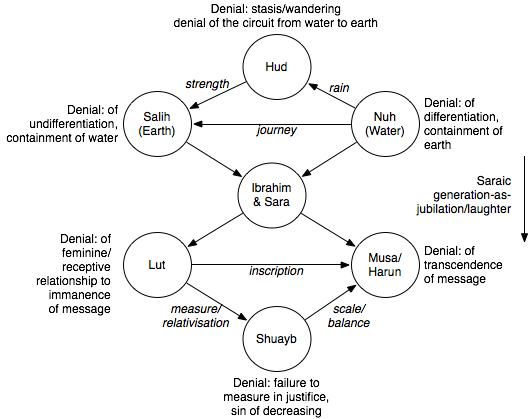
Nuh, Hud and Salih are forms of prophecy that relate earth and water, the left and right. Their associated cities are symmetric forms of denial. Viewed as a triad, they define a genealogical journey from the differentiation/distinction of the human.
The journey begins with the containment of the presence of the Divine, emerging from the southern/right handed waters (Nuh’s ark of differentiation from the waters of immanent love). The journey “moves” into a self-referential predicate of journeying itself: the left handed space of the earth, of judgement. Journeying is a Camel pregnant (by 10 months) with difference, emerging out of the mountains, out of the stabilizers of reality, the poles of logic. It emerges from the same mountains in which Salih’s people make their homes. The mountains from which the Camel emerges are exactly the cosmology presented above -- the diagram we have drawn is a view of these mountains -- but can be viewed as a dialectic of the up and down, of the feet of the human body. As a sign of the journey’s meaning, the Camel is constructed to hold the water of love within itself. The movement of the journey is therefore one of an inversion, in which the undifferentiated water becomes replaced by differentiated earth, the ark that contains the Grace of difference being transmuted into a unitary Camel that contains the Grace of undifferentiated life. The Camel’s pregnancy is the sign of potential, anticipating the realization of Sarah in the process of emanation in the cosmology.
And to Ad their brother Hud. He said, "O my people, Worship Allah. You have no other Ilah but Him. Certainly, you do nothing but invent. O my people I ask of you no reward for it. My reward is only from Him, Who created me. Will you not then understand? And O my people, ask forgiveness of your Lord and then repent to Him, He will send you abundant rain, and increase you in strength, so do not turn away as Mujrimoon" (11:50-52)
This journey into journeying is predicated upon by the promise of Hud. Hud is an arrow between Nuh and Salih. That is, Hud is the binding functor that both results from and precedes all journeys into differentiation: the “opening up” of what a journey is, of what constitutes a movement from south to north, right to left is. Hud is the anticipation of Salih’s camel present within the Nuh’s ark. Relating this back to the prophetic forms of listening and sight, we see that Hud’s promise is a cosmic resonance, sung by him outward into the blackness of all perceptive space, a Truth that constitutes the formation of all Truth, from the vibratory fusion of stars to the dance of celluar structures: for Hud’s promise is exactly listening (rain) and sight (strength), predicating upon the other prophets in their perfect repetition/realization of this promise by their journeys (all arrows from one prophecy to the next, all genealogies of prophecy are rain granting strength).
Each of these prophets has a city that denies.
- Nuh’s city is in denial the differentiation itself, deny the very possibility of differentiation.
- Salih’s city is in denial of the possibility of the journey into life-as-love, instead clinging to the awtad, to the stabilizers within which their homes are constructed. They deny that love is contained within all signs regulated by the stabilization of their sign systems.
- Hud’s city obeys a nomadology (it is an anti-city), denying the promise of Hud, denying the circuit of water/rain of life into strength.
Inasmuch as both the earth and the water can be taken as a dangerous reading of journey (either a loving water that does not differentiate and so contains disbelief and prophecy together undistilled, or a differentiated earth whose signs are closed off and infertile to reading, to love, to water), we can call these the Prophecies of a collective journey that is still not individuated, that is not yet gradiated into plateaus, into the full multiplicity of logics. While containing within itself the notion of individual identities, plateaus and sign regimes (because each is a city, and a city is nothing more than a sign regime), the concept of a city as key to the journey is still internalized.
The city -- the sign regime itself and its problems of denial -- are rendered explicit in Lut, Shuayb and Musa, forms of prophecy whose cities of disbelief concern sins that relate to the problem of values, localization, systematization -- of finding God within individual sign regimes, individual language games. Prophecies only implicitly refer to systems of signage here, they only implicitly refer to their own relationship to cities. Their entire story refers, self-reflexively, to cities (sign regimes) because the schema being presented is also a city. So by drawing it out as we have done, we are also in danger. But the salvation is provided within its own inscription, from within the system, from within the regime. The last three forms of Prophecy identify the danger of cities, a meditation of which will free us from the misprison of the city, that will grant us an exodus (the exodus anticipated by the Camel).
Salih’s people deny the Camel of life, the meaning of the journey (to keep the water). But Lut’s people create a new sin. They comprehend that there are levels of reality, that there is angelic guidance, a realm of forms to the earth upon which the Camel treads. In a sense, they understand there is a cosmology or schema behind things. They have become reflexive enough to understand (beyond Sahih’s people) that the Camel is a sign. But they wish to prematurely grasp those forms (Angelic message) as fully transcendent forms alone, independent of the immanent containment (Lut’s offered daughters) that is, in essence, the transmission of Grace via the forms, via their configuration and active recitation, rather than the forms as they stand. Forms are only grasped via inhabitation: Angelic theorems are only understood by locating their inhabiting proofs, Angelic truths are only understood by active recitation. And that act of proof/recitation is feminine receptivity of light.
From Lut’s system of immanence generation (daughters as living God’s speech rejected in favour of a cosmology of forms), the process of emanation/genealogy leads to its ultimate conclusion of Pharonic civilization. Here the danger is not a premature desire for transcendence and a rejection of Grace’s immanence: it is, instead the declaration of a fascist immanence of the Pharoah’s Demiurgic face, overseeing a system that closes in on itself, denying exodus against a cold war -- and a denial of a God that transcends this space of closed signs.
Shuayb , like Hud, is an arrow. He is an arrow between Lut and Musa/Harun. Self reflexively, the emanation/genealogy is the schema of the Surah itself, being drawn right now in our reading -- it is the system as we have drawn it, as the Qur'an has signed it. That is, the movement from Lut to Musa is a movement OF systematization, of Angelic warning and feminine inhabitation into the Torah that anticipates the Qur’an itself. The movement of transmission into inscription, into trace, into record. Systemization and the drawing of cosmologies are, after all, inscription. There is the greatest danger of the Pharonic/Demiurgic principle in the reading of Divine Systemization, as we well know from the ways in which people read Torah and Quran.
And to the Madyan people their brother Shuayb. He said: "O my people, worship Allah, you have no other Ilah but Him, and give not short measure or weight, I see you in prosperity; and verily I fear for you the torment of a Day encompassing. O my people, give full measure and scale in justice and reduce not the things that are due to the people, and do not commit mischief in the land, causing corruption. (11:84-85)
Thus, Shuayb’s call is the opening of the arrow of systematization that renders the feminine of Lut into the perfect containment within Torah of Musa. His call is the provision of measure and balance -- relativization and scale. To provide good measure is to find a metric system, a valuative framework grounded in justice. But the valuation is necessarily one of relativized rules, the velocity of one body measured against (intersubjectively) another, of a “pure” differentiation that is now actively rendered into a Caucus race of relativities. Another way of putting it is: Angelic forms are not fixed constants, but multiplicitous, totalizing predication -- and the feminine inhabitation is consequently one of relativized plateaus of immanence -- whose function is one of corrective gathering or Prophetic unlocking of signs by means of inhabitation/proof/recitation.
This, in turn, leads to scale, to balance and increasing (rather than the decreasing of Shuayb’s people) in height, through the aeons. Balance is what occurs when the gathering of signs works its way through the circuit of the 6 prophets. And its conclusion is the Musaic exodus -- the release from the misprison of inscription, from the misreading of the Pharoah (reading as magic) into the reading (reading the Reality as nothing more nor less than the speech of God).
**Note 4: The 6 and the seventh
**
The 6 are in resonance with the process of creation, with the circuit of generation of the human mind, with the test itself, the test of deeds, of action, of proof:
And He it is Who has created the heavens and the earth in six Days and His Throne was on the water, that He might try you, which of you is the best in deeds. But if you were to say to them: "You shall indeed be raised up after death," those who disbelieve would be sure to say, "This is nothing but obvious magic." (11:7)
There is not an equality of disbelief and belief -- there is an asymmetric relationship between falsity and Truth. In particular, there is one form or Prophecy that “subsumes” or balances all 6 cities and all 6 forms of prophecy. It is the reason why denial is silent (in this Surah) in relation to the 7th: the Prophecy of Ibrahim, a pure flattening, a Prophecy of submission, a prophecy of unfolding all folds in submission.
In this way, just like the story of the seven kings in Torah, the 7th king is able to contain the light of the former 6. Victory ultimately follows (or is derived) from that containing centre mode of submission.
And his wife was standing, and she laughed. But We gave her glad tidings of Ishaq, and after him, of Ya'qub. (11:71)
Sara’s laugh of jubliation -- as the news of Ishaq -- is at the centre of the Surah’s cosmology of prophecy and denial. The Angels of punishment come to visit Ibraham’s house and he is filled with fear when he understands who they are -- because their “hands” are always associated with fear. The hands, as we have said, are a particular form of Divine action that is completely overwhelming and hence fearful. And yet, in the Qur’an, her laugh precedes the news of Ishaq. This is a tafsir on the Torah’s narration, where she laughs after the news (upon overhearing). Here the temporality is reversed (or rather, corrected) because it is her laugh -- her jubliation -- the Feminine jubilation -- that constitutes the good tiding of Ishaq.
This birth of the child is at the centre of the cosmology of prophecy and disbelief because it is through this cosmology that the child (of understanding-as-jubilation) is born.
Note 5: Nuh’s son
There is the curious tafsir of the Torah here: Nuh's son (known as Kanan or Canaan) leaves to stand on the mountain. He is declared not to be of Nuh's family, to be other than righteous, and is drowned. This narration maps indirectly onto the story of the tent and the vine. There, it is the son Ham who sees Noah naked and drunk, resulting in the curse of Ham being placed upon Ham’s son (Noah’s grandson) Canaan. What is the mapping? It is in relation to prematurity. The son seeks a premature refuge in the stabilizer of the mountain, in an awtaad that cannot assist in the moment of flooding. This is a desire for transcendent escape into the unseen, for a space outside the Ark that can be conceived and seen: an unseen that can be stabilized by a mountain, by a pole, noting that these poles are the regulators of the seen, of creation. But outside the ark - at this point in the narration - is nothing but the unseen as One, and inside the ark is the impossible possibility of our subjecthood.
To desire to be outside is to prematurely gaze upon prophecy within its tent of language/cosmology and attempt to short circuit the journey immediately from water to wine. This premature short circuiting is to perceive in drunkenness (to perceive prophecy drunk), an inadmissible violation of the unseen realm of wine. Hence the sin is on the “son” Canaan, rather than the father, as the Quranic clarification makes certain.