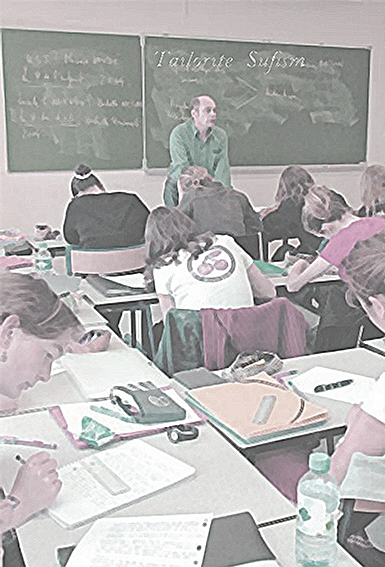
 The year is 3010AD. Verandah Vanguard theological training centre, London.
Principal Farinelly, standing in front of some pretty damn sleepy first years, sighs and brings out his battered teacher's edition of A Tailor’s Doctrine. He begins to read, in his dull Australian nerdtone.
... There is nothing more to war than interpretation: illocutionary acts of (incorporeal) violence, sign substituted for/transformed by sign. In terms of methodology, I wish to emphasize a particular trajectory of lesser jihad -- a particular "potential" of this signs' transmission at this moment in time -- that is particularly excellent, in that it readily brings us into a state of Victory prior to the Martyrdom. (A Tailor’s Doctrine , Fernmind Imprinture, co-ordinates 3-3, S)
“So, uh, is this like the illusion of being free, when in fact we’re just stuck within a demon worship, the worship of the demiurge of constrained thought?” asks one of the more motivated students. Farinelly admires her bounteous curves idly, the stuffy classroom’s afternoon air making his brain as sluggish as much of the class.
Farinelly awakes from his lascivious vagary and offers the following interpretation of that elusive 21st century mystic, that poet, that wine-sipping womanizer, the self-proclaimed "Renewer of the Body's True Science", the Tailor of the Londonstani Golden Age.
**1.
**
_"There is nothing more to war than interpretation: illocutionary acts of (incorporeal) violence, sign substituted for/transformed by sign."
_
Most Tailorite scholars are in consensus that the Tailor studied philosophy in his early years, possibly at the University of Auckland in New Zealand. To interpret the Nerd of Namaz, it is often useful to do some archeology into the kinds of philosophy that was popular at his time as he seems to take delight in subverting and misreading his secular contemporaries.
By "illocutionary acts", the Tailor is playing with a long forgotten concept from 20th century philosophy -- so-called Speech Act theory. These are forms of statement that, when pronounced, do not merely make a true/false statement about the world -- they also change the world.
For example: "You are under arrest" -- when a policeman says it, it is both a) true and b) an action that makes itself true. Similarly: "I now pronounce you husband and wife" is a) true and b) an action that creates a truth (the marriage's commencement) when uttered by a priest. Or (in terms of warfare): "Britain is now in a state of war with Iraq" is both a statement and an action that makes the statement true when uttered by the prime minister of Britain. Or (in terms of religion): "There is no Allah but Allah and Muhammed is the Slave and Messenger of Allah" is both a statement of submission and an action that makes the seeker submissive when uttered by (a real!) seeker. And so on ...
These are illocutionary acts, each with different purposes. But we can draw a linguistic classification around the lot of them.
An important feature of these acts is that they only "work" when an appropriate subject is uttering them: for example, the marriage pronouncement has no validity if made by the policeman, while the declaration of war won't be effective if uttered by the priest. There is a kind of intentional -- niyattian -- dimension that is key here.
**2.
**
"... illocutionary acts of (incorporeal) violence, sign substituted for/transformed by sign."
The Doctor of the Deen believes there is "nothing more" to the universe than signs. He takes this in the literal sense of linguistic signs: the universe is nothing more than a book of signs written by the Divine Author. Ultimately, these signs have an ultimate meaning: they refer to this authorship -- they refer to the Source of Love that breathed them out.
But our subjective journey is one of "falling into" this sea of signs. Obviously we cannot apprehend all the signs of the cosmos: instead, we make choices, utter statements, fall in and out of love, have babies, buy groceries, go to school, go on holiday, go to work, retire, drop out, encounter others, etc ... If the world is a sea of text, a sea of signs, then all these individual activities are "linguistic" activities -- or "deeds inscribed". They are activities that involve gathering signs up around us and collecting them into a garment that simultaneously traces and records our passage through the signs.
The Tailor writes elsewhere (most poetically in his later work, the Medinan Ascention) that this process of "gathering" signs -- weaving the signs of the cosmos we choose to encounter -- is exactly life -- and is exactly what Time is. Time is not measured by a clock -- it is measured by the deeds we enact, the weaving of a garment of choices, the runtime trace of our subjective journey back to the Beloved. The Jewish mystics have related "deeds" and "choices" to "days": this is why in Torah it is very significant to enumerate the ages of the Prophets. That number of their "days" encodes their "wisdom", their Prophetic trace (the Prophetic trace, expounded upon in the final chapter of the Doctrine , has a prime privilege in "both its closure and invitation to becoming").
In Judaism, this life-as-gathering-and-configuring-signs -- is called this a "robe of days". The Qur'an refers to it as a "book of deeds". Our own little book, our own little path -- formed through swimming, choosing, enacting, living through and collecting the signs of the Big Book.
In other words, as he writes in his populist philosophical blockbuster, the Seals of Co-Induction
life = autobiography
How is this gathering enacted? Through illocutionary acts. Each time we reconfigure signs to add to our little autobiography, to weave into our garment of days -- we are both a) uttering/choosing a truth/falsity and b) realising it as true/false in our lived autobiography by uttering it/choosing it.
Nothing physical is happening here yet: we are still "only" in a realm of signs. Illocutionary acts do not change the True nature of the Body. They just allow us to play one particular game (e.g., the game of living as an accountant in the Bodega Bay is constituted by a whole bunch of illocutionary acts, necessary to weave an accountant's robe of days). Or they allow us to "jump" between games (e.g., ceasing to be an accountant and dropping out to be a bum, wandering the country). Jumping between games requires particularly violent illocutionary acts, because they transform one field of signs into another field of signs.
Some forms of "jumping" between games are disastrous and evil. He might, for example, decide, in some moment of Dostoyevskian freedom, to commit a murder for the hell of it. He would jump from the accountant game into a different game. Say he stabbed his landlady. This jump between games would be managed by an illocutionary act -- his willful configuration of the sign of a "knife" to the sign of the "landlady". Blood would be shed, but as an afterthought. The key thing here is his evil choice to configure these signs -- and in configuring them, making the False manifest.
On the other (right) hand , let's talk about the "jumping" involved in lesser jihad. Tailorite Sufism has grown to be only form of legitimate mysticism within the galactic alliance, thanks to the efforts of the lions of the Verandah Vanguard-Hyper-Sobornost alliance. And yet only some choose it, whilst others do not, preferring their various cultural situation. Let's imagine our accountant is compelled to join our Vanguard: to drop out of it all and change his garment into a patchwork field of wool. Such a "jump" is also a violent transformation. Let's imagine that he is compelled to do this by encountering a teacher (who might be real or come to him in a dream) who asks him "to survey his debts". This question will be a violent (nonphysical) illocutionary act that, in utterance, will change the accountant, and make him jump from one game to another. A lot of the signs the accountant encountered before will need to be reconfigured/swapped/replaced in order for him to fully enter into the game of Sufism. For example, the sign of "debt" will change from what was "merely" a column heading on a spreadsheet -- into a greater form of "debt" -- a cosmic debt that, ultimately, signifies and refers to his relationship to the Divine.
Anyway, that transformation -- of awareness -- will be brought about through participating in lesser jihad -- in this case, on the wrong end of the stick. The teacher has waged a war against him and, with one key illocutionary act, has shifted the accountant's game. But the accountant Sufi will now find himself a player in this new game, with a new set of illocutionary acts to recite (reciting signs taking the form of reading Qur'an, hadith or just perceiving his children playing in his garden). Each of these acts of recitation will be similar to the jihadic act of the teacher -- some will be violent, some will be nonviolent -- all will not involve physical blood -- and all will be transformative with respect to his subjectivity. The accountant will now reside in Medina, in the city of Prophecy (that still exists today, not in that geographical place exactly, if we are to believe the authentic hadiths). Lesser jihad will be over for him, momentarily, at this point.
If the accountant becomes a teacher too (maybe to others intersubjectively or to the various armies roaming his mental geography), then his acts of recitation will then constitute a lesser jihad, because he'll be doing unto his neighbour as was done unto him.
3.
"In terms of methodology, I wish to emphasize a particular trajectory of lesser jihad -- a particular "potential" of this signs' transmission at this moment in time -- that is particularly excellent, in that it readily brings us into a state of Victory prior to the Martyrdom."
Despite his absolute self-righteous belief in his carrying the torch for True Sufism, the "Hound-Dog Salafi par excellence" and the "Tailor of the True Garment of Prayer" -- and even "Seal of Tailors" (although in this he acknowledged his debt to the Seal of Sainthood, ibn Arabi, who he claimed to have met in a formative vision in Sweden), this peculiar little mystic always admitted to be "just" a teacher amongst a great number of equally valid teachers. And while he "Sealed" Tailoring, he never denied that the Teaching would continue to bring about new and original perspectives on the Truth after his passing -- as his poetic muse the Matronita Minor sings with their rock band the Friends of Design :
It's our law: "dictated needs of the time"
To the core, there's still more, back to the wall! (The Friends of Design,The Porch , Eponymous album)
His main novelty is his restricted attention to the Qur'an and the material associated with the salaf, the early generations of seekers.
Note this point well, as it is examinable! The Doctor of the Deen never claims that this gives him any kind of historical authenticity as might be claimed in so called fundamentalist religion. He has refuted historical authenticity -- because of this notion of Time mentioned above (which in a way denies ordinary tick-tock history). In particular, he freely admitted that all his understanding of the narrations and holy books came from his imagination, was "made up", a "subjective projection" upon the matter of that religion. But he believed that this illocutionary act of subjective projection was itself captured and understood by Prophecy within the subjective projection -- and through this process of self-reflection, his "projection" was one of True Light onto a dark matter. Ultimately he believed that this particular form of subjective projection was itself the Truth -- a Truth of Divine contact that he wished to share with all humanity.
So, this projection itself, made onto this particular "authentic" material -- forms technology of Light and is the means by which this lesser jihad can be performed on himself and upon others. He was largely ignored in his own time -- it is said he had only 14 or 15 followers, all women, including his wife -- and 8 of these were women he encountered in dreams! But "history" has shown the galactic benefit of his righteous garment.
One interesting feature of Tailorite tafsir is the focus on the the "worst" sounding hadith and verses of the holy books: often these are the key to entering into this state of Medina. That they sound so awful and are often violent -- within the context of a religion of love -- should be the key to their deeper (and complex) truth: their (incorporeal, non-physical) violence is a property of their being armaments in a lesser jihad waged both by and against the reader.
For example, he believes his interpretation of the Banu Qurayza hadith is exactly what the hadith refers to: an assult on one game of life that allows us all to "jump" into the game of Medina.
And then prepare for the greater jihad ... We'll cover that next week.