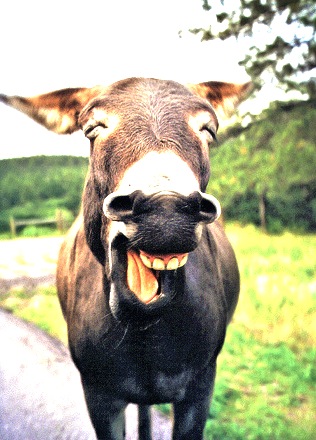
 It has been be argued (within certain Sufi circles, specifically, those of the Tailorite disposition) that we (or at least me, most of the time) are hardly ever Muslims but are, instead, “merely” Ahl al-Qitab. Embodying (albeit faithfully, sincerely, beautifully) the rules, carrying the signs of God upon our backs: but not yet reflecting, not yet reading. When the Books of God are carried upon our backs, we are as holy donkeys following a particular path, "we" cannot read them, so do not know what they signify, but, nevertheless, we carry them forward into the "future". Perhaps, at a later date, others might take from what the donkey carries and carry it through reading the script.
In other words, Prophecy is still going on right now, and the goal of the journey is that we recover Islam, we, the embodiers of a practice of Islam, we the people of the Book, awaiting his entrance into the Medina of our heart.
Those who were entrusted with the Torah but then did not carry are of a likeness to the donkey (HMR) who carries books. (62:5)
This is not a verse meant to enjoin a sense of smug religious superiority upon Muslims. It is a universal cosmological reading of the relationship between the (collective and individual) soul, its journey and self-awareness.
Quick tafsir: The donkey is what we normally think of as selfhood, as subjectivity — secular or religious, it doesn’t matter at this point. Sufis call it the nafs. It carries “books” but without really carrying, without reading what "books" are. The "books" are, in fact, the autobiographical inscription of the donkey's own journey, rendered through the qalbic prism of self-awareness, the purification of meta-reflection: it carries as a donkey because it is not yet able to carry Torah as a Submitter whose selfhood has been illuminated to rise above the "everyday" realm of the donkey and into the realm of the rider who knows what the donkey and its journey constitute and can carry the books of autobiography in this knowledge into the qalbic realm of Malakut/Yetzirah.
When we realise this, we understand that we have been entrusted with revelation.
As the collective soul (broken into individual souls) of the ummah, we embody it, we carry it but do not carry it, we carry it upon the back of our water-body nafs, but we do not see it for what it is, we do not carry it, because the collective soul has not been awoken. Instead we embody it, a walking text, for future generations of the collective to, eventually, comprehend.
To hasten this process, if not collectively, then individually (the individual soul still being a microcosm for the ummah) we should ask ourselves, what must be done to find ourselves as riders, so that we may read and carry the book as riders.
Long aside on donkeys: God treats donkeys in various ways in his Books.
In (74:49-50) Allah describes those who turn away from the truth as like donkeys running from a lion. In (31:19) Hu says “the harshest of all sounds is the voice of the donkeys.” And yet, in (16:8) the donkeys are described as a gift to us from the creator, granting us transport and adornment. So donkeys, that part of us that carries us, is also an adornment to our being. Then there is the famous talking donkey of Balaam, the false prophet, in B'midbar/Numbers — the donkey resists his movement along a particular path, though the rider (granted access to the higher realm, but abusing this access) mistreats it.
A donkey in Torah and Islam always stands for a “lower” aspect of selfhood, that shell which carries our higher selfhood -- the orders of our soul -- upon the journey. It is interesting that the Arabic for “books” here, asfaran , has SFR as its root, from which we also get a meaning of inscription and journeying.
Thus, while they do not carry the Torah as a rider carries — in the sense of coping and reading its signs — their donkey, the journeying, inscriptive, textual subjectivity, navigating the space of discourse — still carries the signs upon itself — as a simultaneous book and journey/self-inscription.
That is, by realising we are not Submitters at all, but in fact still Ahl al-Qitab existing within the lived space of Nasut, it is our paradoxical, contradictory station to carry the journey/books/autobiography upon our nafs, precisely by virtue of the fact that we cannot yet carry/comprehend the nature of the Book as autobiography of our journey as a donkey!
Musa, without a doubt you have the most original take on these matters; one that echoes the breathtaking originality of the Classical Sufis, and which is a positively scintillating in this era of cautious repeaters.
"Thus, while they do not carry the Torah as a rider carries — in the sense of coping and reading its signs — their donkey, the journeying, inscriptive, textual subjectivity, navigating the space of discourse — still carries the signs upon itself — as a simultaneous book and journey/self-inscription."
Here's a thought. The word for ass used in this ayat - al himaari - comes from a root which comes from the idea of paring something down to its essentials. Other concepts from the same root include excoriation - flaying away the skin - and (in more common parlance) redness (presumably from because flayed skin reveals redness beneath. And one might assume that the poor donkey (which is hardly red) is linked with this root because of the chafing burdens it carries.
So, following your interpretation, we might say that those who fail to bear the burden of the Torah (somehow this got lost from your quote) still carry its signs upon themselves, in much the same way as the ass bears the 'impression' of the books it carries, not in the form of knowledge, but as raw sores from their sheer weight upon its back.
Peace James,
Thanks, as always, for your encouraging feedback! I think you are onto something with al himaari :)
I think our conversation within this blog often touches on donkeys and riders (in the space of religion). In fact, the donkey often raises its head whenever Sufism is brought up in polite society. So I thought this brief observation was quite fun!
Mu
BTW, I loved your ahl al-Qitab : yes, people of the 'pole', not 'people of the book'.
Dear brother Tailor,
This, as our friend James has said, truly a wonderful and original piece. Loved it and loved your exposition on the symbology of donkey. With your kind permission I would love to share it as well in the mysticsaint blog.
Peace!
Peace upon you too, Brother Jeweler!
Thanks for your encouragement. I am honoured that you would consider exhibiting this little piece amongst the glories of your shop window. Permission is always granted :)
Love and Light,
TT
praised be Hu!