There was once a mausoleum of a great Muslim saint that was a focus of pilgrimage. He was famed for many miracles. Muslims would come from far and wide to pray at the grave and ask for their child to be healed or that so and so... would marry them and would tie prayers to the tree next to the grave and so on. An old Sufi tended the grave and had a simple bed in one corner and as the pilgrims left they would give him money or food so that he was able to live comfortably.
Joha came to him and wanted him to teach him his ways of abstinence, piety and service to Allah. So he slept in another corner with the old Sufi for many months as the old man taught Joha all he knew.
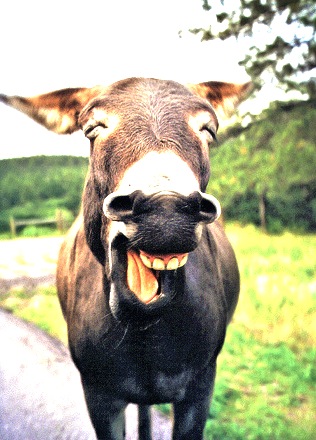
Then one day the old Sufi said: "It is time for you to go and find your own way. Here take my old donkey and go in the protection of Allah!"
So off Joha went into the desert for many weeks. Sadly while on his journey the old donkey died and so he buried it in the spot it fell. As he sat on the grave wiping his sweat away a passer by saw him in his Sufi robes and immediately assumed the grave was of a great saint and came and prayed by it and then gave Joha some money.
Stunned Joha didn't say anything. The man told others of this saint in the desert and more came. Joha built an enclosure and stories spread about the wondrous works of this saint and how he cured illness and answered prayers and Joha started to live a very comfortable life with all the donations from contented pilgrims.
But he eventually felt deeply guilty about what he had done and returned to the old Sufi to confess his sins and seek forgiveness.
The old Sufi smiled. "Do not feel bad my son. You see this grave that I have tended for many a year? It is the mother of the donkey I gave you."
This story works at a number of levels.
-
It's about the way religious culture builds up like a "crust" around "events" that are actually completely orthogonal to culture and religion. It's like how you get towns and villages built near old volcanoes because the ground is more fertile there: but the event of the volcano erupting itself has nothing to do with these towns and villages (known in Tailorology as the "volcano and village routine"). And in fact are mutually exclusive: if the volcano were to erupt again it would wipe those towns and cultures until nothing remains but the face (of the earth).
-
The story concerns the impossibility of communication, in the ordinary sense of one agent (or book or story) A communicating something to another B. The impossibility of a telephone call: A calls B, A informs B. And I don't mean this in the sense that Truth is necessarily some kind of "non-verbal" Enlightenment lesson. The story concerns the separation of concerns and (ironic) co-dependency between carrier signal and "that which is carried", which is nothing more nor less than a blueprint of this whole process (known in Tailorology as the "kiss-o-gram" routine).
-
The standard Sufi tafsir on the donkey is that it represents the "nafs" of the human soul in transit. The ego. But not just the ego -- lots of things are "nafsic". Things like religion, like culture, like the things into which we are thrown.
Donkeys are not a bad thing, in the wider scheme of things. Carriers are a blessing. Contrary to populist suggestion, the Tailorology isn't anti-nafs, it isn't anti-ego or anti-donkey. In (74:49-50) the Qu'ran describes those who turn away from the truth as like donkeys running from a lion. In (31:19) it is said “the harshest of all sounds is the voice of the donkeys.” And yet, in (16:8) the donkeys are described as a gift to us from the creator, granting us transport and adornment.
So Joha's donkey, his carrier, his adornment was a blessing from his teacher. Then it perishes along the way. His attachment, his culture, his Sufism, his learning, his Islam -- they are the donkey his teacher imparted to him, and they have perished at that grave. His own personal "let go" event. I trust some of you know what I mean by "letting go" here.
But the irony of the Tradition is that the moment a Sufi has a "let go" event, they get showered in wealth -- another culture, tradition etc -- builds up around them. It's the irony of revelatory, Divine experience: it always exists within a misprison of (some) Tradition. It is spelt out to us in tension with the words/prison bars of a Tradition that, in and of itself, as code-for-codes' sake, denies its immediate transmission. Except for the fact that the story (and the Tradition) has encoded the "let go" self-reflexively in its carriage, its carrier carries the self-prophecy of its carriage, the crust of our immediate apprehension and the volcano of our potential comprehension, its own death.
A crust has formed around this very story. These teaching stories are silly and charming and quaint. Picture it being told by some lovely grey haired hippie convert Sheikh, white robes and immaculate beard, surrounded by an admiring bourgeoisie of sisters (cousins and aunts). Somewhere over in Kensington perhaps. Not like the hardcore martial rules and regs of the jackbooted Islamists here in brown-town.
The story appears to us in 21st century London as charmingly quaint and "user-friendly". A Sufi Zen koan. Dinner party material. But it's the very opposite: it's a sword that cuts deep, it's shariah, the most fearful shariah.